A board that holds context, not just statuses
Each application card can include the vacancy, notes, documents, and next-step AI workflows behind the stage label.

Use case
Track job applications, role-linked artifacts, and interview progress in CareerBoard without scattering the search across spreadsheets, docs, and folders.
Why CareerBoard
CareerBoard works best when you want every role, document, interview, and AI workflow to stay connected instead of resetting across separate tools.
A board that holds context, not just statuses
Artifacts stay tied to the right role
Collaboration becomes simpler
Why this workflow
A tracker only becomes truly useful when it holds the real work around each application. CareerBoard keeps the vacancy, resume, notes, prep, and review history attached to the same card so the board stays operational, not decorative.
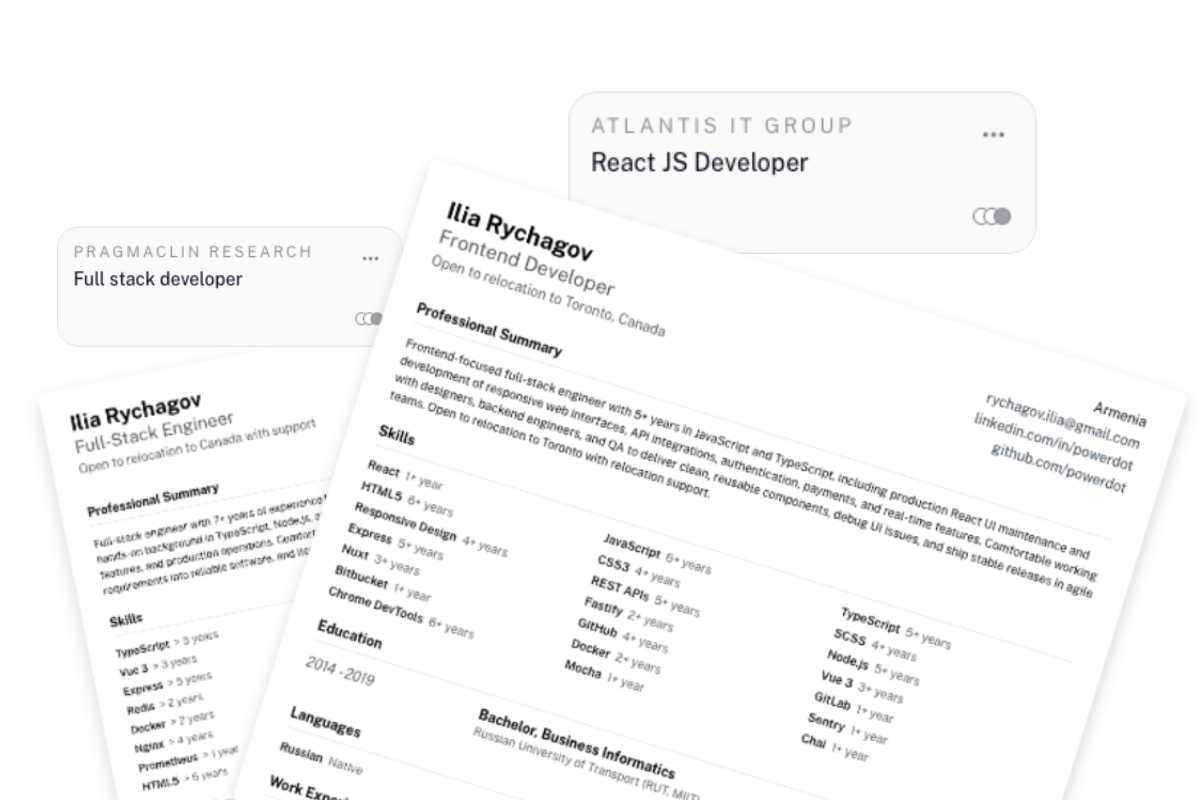
Each application card can include the vacancy, notes, documents, and next-step AI workflows behind the stage label.
Resumes, cover letters, prep packs, and interview reviews remain attached to the application they belong to.
Anyone helping with the search can inspect the same role context instead of piecing it together from folders and chats.
Workflow
These steps stay anchored to the same role and project context instead of being spread across unrelated tools and repeated prompts.
Keep the original vacancy link and copied job description with the application from the beginning.
Track stage changes while keeping the supporting notes and generated artifacts visible on the same card.
The board becomes a control surface for the search, not just a place to log outcomes after the work is already done elsewhere.
Outcome
The value is not only the generated output. It is the continuity between earlier and later steps.
You stop maintaining one tool for status, another for documents, and another for interview notes.
Opening a role shows the pipeline state, the sent assets, and the preparation history in one place.
It becomes easier to decide what to resend, improve, or revisit after each stage of the process.
Best fit
CareerBoard is strongest when the work around the output matters as much as the output itself.
People whose current tracker tells them where an application is, but not what was actually sent or prepared for it.
Applicants who want every role to keep its own resume versions, notes, interview prep, and review history.
Collaborative searches where another person needs to understand the state of an application quickly without hunting through files.
Questions
Short answers for what this use case page is and is not claiming.
Next pages
Move to another workflow, a comparison page, or a public integration page.